
By: Felix Ikpotor
Amnesty International (AI) says it has uncovered evidences of negligence and deliberate failure by Shell Petroleum Development Company Limited (SPDC) to protect the Niger Delta environment during it’s over 60 years of operations in the region.
The organisation stated this during the official launch a report titled, “Nigeria: Lifting The Lid,” examined SPDC’s operations in the Niger Delta region before it was sold to Renaissance Energy Africa, saying that the company continued operations despite documented evidences of faulty and weak facilities in some areas of their operations.
The report by Amnesty International (AI) blamed the several oil spills and environmental degradation of the Niger Delta region on negligence by Shell Petroleum Development Company (SPDC) now known as Renaissance Energy Africa.
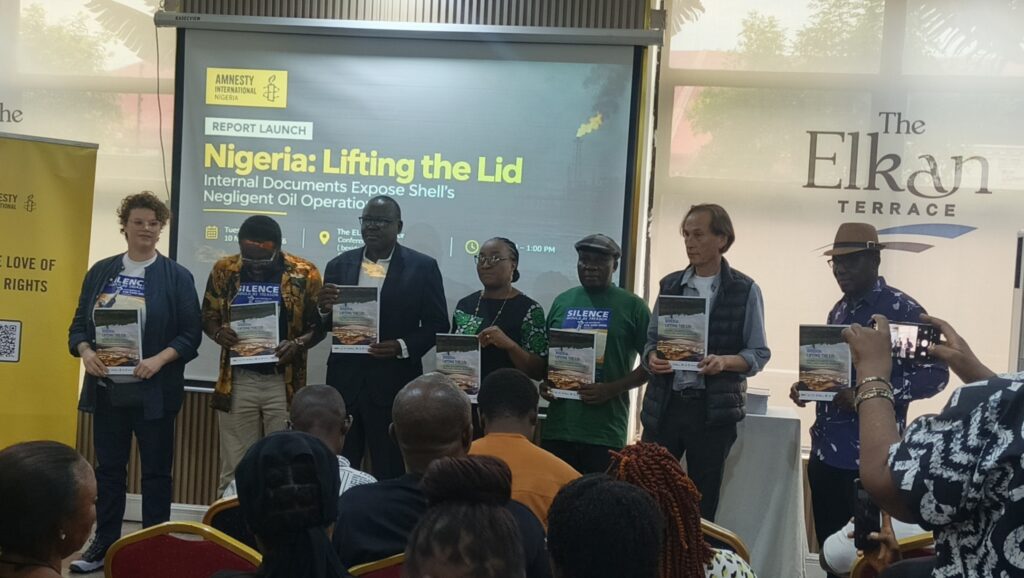
The report which was published in partnership with human rights organisations such as The Corner House, Hawkmoth, Human and Environmental Development Agenda, Kebetkache Women Development and Resource Centre, Mideekor Environmental Development Initiative (MEDI), ReCommon, Social Action and Somo Centre for Research on Multinational Operations, accused the company of prioritising profit over the health and wellbeing of the people of the region.
Dominic Twommey, Amnesty International’s Campaign Network Coordinator, Business and Human Rights while presenting the report virtually in Port Harcourt, also accused staffers of the company of complicity in bunkering activities and bribery.
Twommey said the report was based on documentary evidences, emails and court documents assembled overtime, including the case of SPDC versus Bille and Ogale communities in Rivers State.
The report said a cache of internal documents recently disclosed in legal proceedings in the UK against fossil fuel major Shell PLC have lifted the lid on its negligent and polluting operations in the Niger Delta.
It said: “Most of the documents-which include email exchanges between senior executives and confidential audits-have not been previously reported on. Most were released after a group of campaigning groups applied for their publication on public interest grounds. Other Shell documents were cited in legal documents, in a case brought by two Nigerian communities against Shell in the UK. The two communities, Bille and Ogale, claim that Shell failed to prevent and then remediate devastating oil pollution over many years.”
“The documents’ content vindicates the long-standing complaints of people living in the Niger Delta, as well as the research findings of human rights and environmental justice groups, including those publishing this report, that a significant cause of the pollution lies in Shell’s failure to properly maintain the vast network of wells and pipelines operated by what was then its Nigerian subsidiary Shell Petroleum Development Company (SPDC)”.
The group said Shell deliberately refused to maintain its infrastructure in line with international standards, prevent spills, adequately clean up and remediate pollution, and disclose information on the condition of its infrastructure and the impact of the operations on people and the environment.
It noted that in 2009, Shell’s Design and Engineering Practice policy for pipeline repairs was revised specifically for SPDC’s operations, adding that the revisions not only allowed temporary clamps to be used as permanent repairs to leaking pipelines but also allowed the continued operation of the pipelines where illegal taps were not actively leaking.
Amnesty International made the allegations despite Shell’s claim that it managed its infrastructure to international standards and that most oil spills were caused by thieves tapping its pipelines and wells.
The report called on the Government of Nigeria to require all fossil fuel companies operating in the country to conduct and publish audits of the condition of operational and decommissioned Infrastructure.
It also urged the government to conduct studies into the impact of pollution associated with oll extraction has had on the human rights of affected communities (health, water quality, fisheries & agriculture) and take remedial action.
“Require all fossil fuel companies operating In Nigeria, Including Shell, to contribute to a superfund to clean-up the Niger Delta to international standards, urgently initiate a clean-up programme to international standards and investigate the alleged complicity of Shell staff in bunkering and bribery, ” it demanded.
Amnesty International further called on the Government of United Kingdom and the Netherlands to investigate if Shell has infringed financial market rules by making misleading statements to shareholders with regard to its environmental, social and good governance standards and their application, investigate the alleged complicity of Shell staff in bunkering and bribery and introduce legislation to require companies to conduct human rights and environmental due diligence across their global operations and supply chains, with a monitoring mechanism and an enforcement procedure.
It urged the UK and Dutch governments to, “Ensure Shell’s directors are personally held to account for their involvement in the despoliation of the Niger Delta and for associated human rights abuses”.
To meet their obligations under environmental and international human rights law, AI said countries like the UK and the Netherlands, must also rapidly provide adequate, new, additional and predictable finance to support lower income countries, including Nigeria, in reducing emissions and adapting to climate change.
Responding to the report, Isa Sanusi, Nigerian Director, Amnesty International said the group will write to the Nigerian government soon to ensure the implementation of the recommendations of the report.
He also said there is the need for thorough clean-up of the entire Niger Delta region, saying cleaning a part (referring to the ongoing Ogoni clean-up exercise), was not enough.
“We are also calling on all fossil fuel companies operating in Nigeria, including Shell, to contribute to a super fund with sufficient resources to fully clean up Niger Delta to the international standard. There is no way you can just clean one small place and think that you have done clean up for the whole of Niger Delta. They deserve good environment.
“We are also calling on them to investigate the alledged complicity of Shell’s staff in bunkering and bribery. We hope the Nigerian government is listening and will continue to make these recommendations.
“We are also writing to the president very soon and send him a copy of this report to make sure that they receive it and they must act on it, ” He added.
Eva Pastorelli, a campaigner with ReCommon in her speech, said through the report presented, they have made everyone to know what Shell has been doing in the Niger Delta region over the past 60 years and their responsibilities.
The activist also said the report showed that the highest level of Shell’s managers here in Nigeria are complicit in the alleged operational negligence leading to pollution of thevNiger Delta environment.
“Through evidence-based proof, we have shown that all the levels of the company could be held responsible for not doing things or not have done things. So, I think that this is the first chapter of what can come next regarding any Shell responsibilities in the Delta region” She stated.
She said her assessment of operations of multinational companies in the region shows so much lack environmental justice, degradation, abuses of human rights amongst others.
Pastorelli said the multinational companies should be held accountable to pay for damages.
In his goodwill message, Dr Celestine Akpobari, Team Lead of MEDI, urged Amnesty International to look into the issue of divestments by multinationals especially SPDC.
He said it was wrong for them to mess up the Niger Delta environment and run away under the guise of divestments.
“This issue of divestment is a problem. Ogoni will not be clean until all other parts of the nation are clean because we are linked together. Ogoni is not an island. So therefore, those that ran away in the name of divestment must come back to clear up their mess. Who are you leaving the mess for?
“So I think that Amnesty International must put their teeth in this matter. Let’s see what we can do to reverse that, clean up this mess and restore our environment, so our people can go back to their fishing in the communities, ” Akpobari appealed.
