
By: Felix Ikpotor
Stakeholders in environment and the media, have intensified calls on the Federal Government and multinationals to urgently the Niger Delta, warning that persistent environmental pollution has continued to devastate livelihoods and worsen socio-economic challenges across communities in the region.
They also stressed the need for sustained media attention on environmental issues affecting the Niger Delta, noting that consistent reportage remains critical to drawing national and international attention to the plight of affected communities.
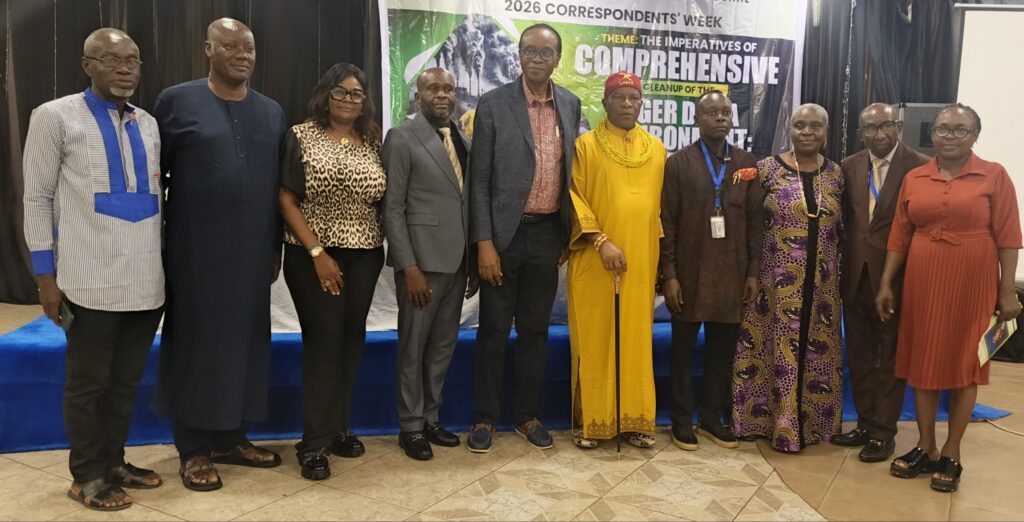
The stakeholders spoke on Monday during the opening ceremony of the Correspondents’ Week organised by the Correspondents’ Chapel of the Nigeria Union of Journalists (NUJ) in Port Harcourt, Rivers State.
The event, themed, “The Imperatives of Comprehensive Clean-Up of the Niger Delta Environment: Role of the Media,” was supported by Renaissance Africa Energy Company Limited, Nigeria LNG, and Kebetkache Women Development Centre.
Delivering his remarks, the Paramount Ruler of Upata Kingdom, His Majesty King Felix Otuwarikpo, Ph.D, Eze Igbo Upata III, called for an amendment of the Petroleum Industry Act (PIA), arguing that certain provisions unfairly hold host communities responsible for oil theft and pipeline vandalism.
The monarch explained that although Section 437 of the PIA allows part of the host communities’ fund to be used for repairs of oil facilities damaged through sabotage, oil companies have continued to depend largely on security agencies to protect pipelines while sidelining the communities.
He further alleged that some actors within the oil industry are behind cases of pipeline vandalism and crude oil theft in the Niger Delta.
King Otuwarikpo also accused the Federal Government of failing to give adequate attention to the environmental and developmental challenges facing communities in the Niger Delta.
He called for stronger collaboration among stakeholders to ensure effective environmental remediation and improved living conditions for people of the oil-producing region.
“The environment is very key and attention is usually not given to the environment because most of the consequences we suffer at the community level do not happen at the GRA,” he stated.
In his goodwill message, the National Vice President, Zone F, of the Nigeria Union of Journalists, Mr. Opaka Dokubo decried that mangroves that provided livelihoods for local communities have been converted to tank farms, thereby fuelling poverty and hunger.
“Our mangroves have now been converted to tank farms. The mangroves that put food on the tables of the Niger Delta and trained most of their children through schools have now been converted to tank farms,” he stated.
He thanked the chapel for sustaining the yearly event.
On her part, an environmental activist, Chief Constance Meju, tasked journalists to humanise their environment stories, stating that the situation of the Niger Delta has been underreported. “Crime has continued to increase in the region because we have lost our sources of livelihoods,” she stated.
Earlier in his Welcome Address Chairman, Correspondents’ Chapel, Mr. Amaechi Okonkwo, stated that the event is not just another ceremonial gathering, but a solemn call to conscience.
“It is a call to action on one of the most critical issues confronting our region and indeed our nation, the continued degradation of the Niger Delta environment and the urgent need for a holistic and comprehensive clean-up,” he said.
Okonkwo observed that the Niger Delta remains one of the most environmentally devastated regions in the world despite being the economic backbone of Nigeria for decades.
“Our land, rivers, creeks, and forests have suffered extensive pollution arising from oil exploration and exploitation activities, illegal refining, pipeline vandalism, gas flaring, and years of environmental neglect.
“Communities that once depended on fishing and farming for survival now struggle daily with contaminated water, destroyed farmlands, loss of biodiversity, and serious health challenges. The painful reality is that many of our people continue to live in conditions that fall far below acceptable environmental and human standards,” he said.
He observed that though the Federal Government commenced the clean-up of the Ogoni area, years after the recommendation of the United Nations Environmental Programme (UNEP), recent reports for other areas on the effects of the pollution on the people is frightening.
“It is against this backdrop that we chose the theme for this year’s Correspondents’ Week: “The Imperatives of Comprehensive Clean-Up of the Niger Delta Environment: Role of the Media,” he said, describing it as timely and relevant as environmental justice can no longer be postponed.
“The future of the Niger Delta depends greatly on the decisions we make today regarding environmental remediation, sustainable development, and responsible governance,” he said.
Okonkwo tasked the media to sustain the call for the cleanup of the entire region so as to safeguard future generations.
“As journalists and media practitioners, we understand that the media occupies a strategic position in shaping public discourse and influencing policy direction.
Beyond reporting events, the media must continue to serve as the voice of vulnerable communities, the watchdog of society, and the platform for accountability.
“The media must sustain advocacy for environmental protection by drawing attention to ecological challenges facing our communities, amplifying the cries of affected citizens, and holding governments, multinational corporations, and all relevant stakeholders accountable to their environmental responsibilities.
“We must also continue to educate the public on environmental sustainability and support initiatives aimed at restoring the ecosystem of the Niger Delta for present and future generations,” he stated.
